1. Difference between A1 and A2 type milk?
Casein is the largest group of proteins in milk, making up about 80% of total
protein content. Beta-casein is the second most common type.
The two most common forms are A1 beta-casein and A2 beta-casein:
- Milk from **foreign breeds** (Jersey and Holstein Friesian) contain **A1
protein**.
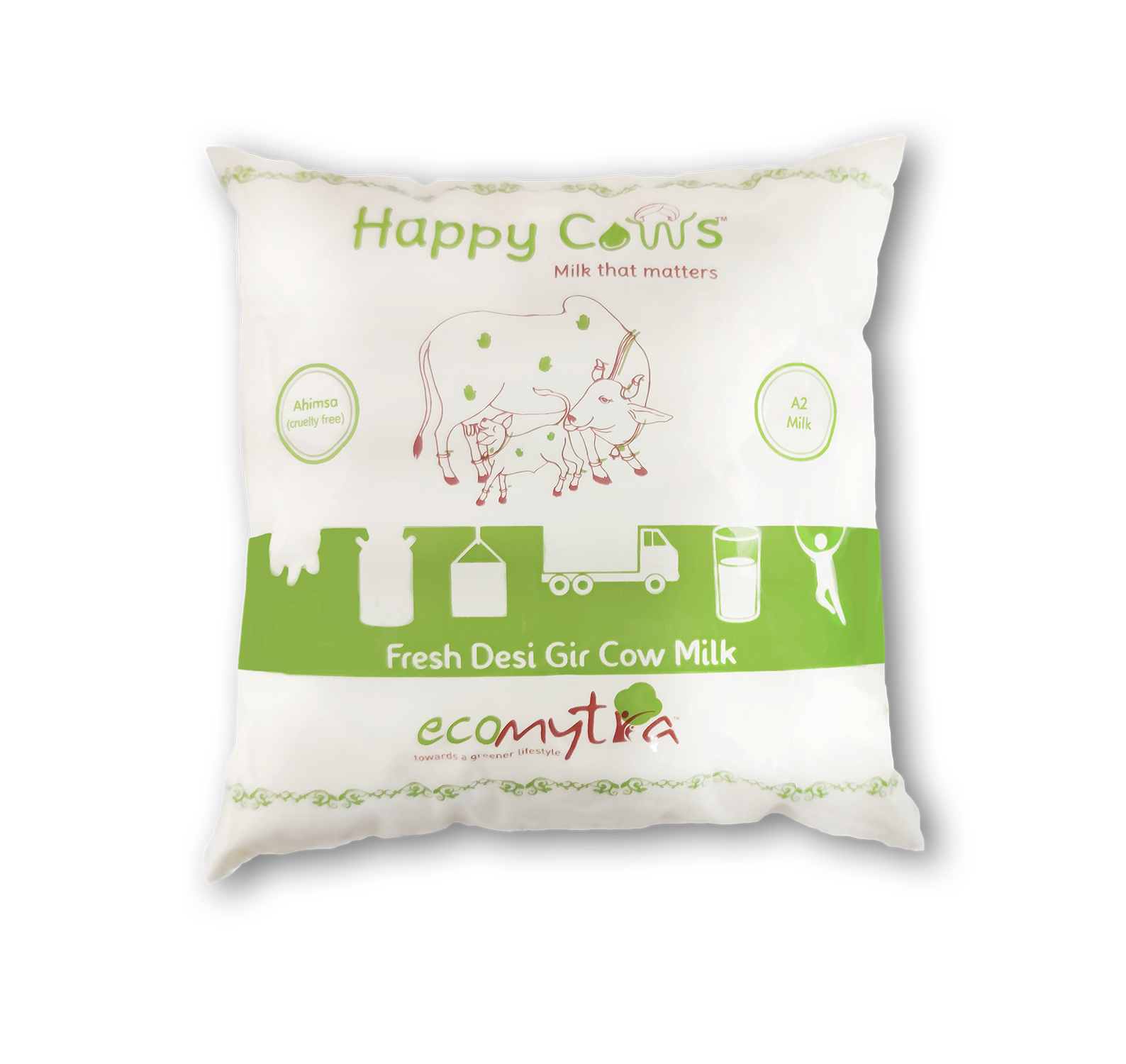
- Milk from **Indian cow breeds** contain **A2 protein**. Happy Cows Milk is
A2 milk.
2. What makes Happy Cows milk special?
Our milk comes from free-grazing, cruelty-free cows, ensuring
purity and natural nutrition in every drop.
3. Harmful effects of A1 milk?
The presence of an amino acid called **BCM 7** makes A1 milk potentially harmful
for consumption. Few reported effects include:
- Type-1 diabetes
- Cardiovascular disease (IHD)
- Delayed psychomotor development among children, autism, schizophrenia,
sudden infant death syndrome (SIDS)
- Auto-immune diseases, intolerances and allergies.
- Higher risk for those with digestive disorders like stomach ulcers,
ulcerative colitis, Crohn’s disease, Celiac disease, or those on long-term
medication/antibiotic treatment.
4. Benefits of A2 type of milk?
- Prevent obesity among children and adults
- Improve brain function
- Promotes digestion
- Increase breast milk production in feeding mothers.
- Prevents joint pain, asthma and mental problems.
- Promotes good kidney health
- Increases immunity
- Reduces acidity
- Helps in reducing chances of colon, breast and skin cancer
- One of the best natural anti-oxidants
- Detoxifies Body, Enhances Memory Power, Increases clarity of Voice
- Helps in reduction against PMS symptoms in the menstruation cycle
- Prevents migraine headache, Good for thyroid
5. Comparison of Indigenous Indian Cows (A2) and Foreign Cows
(A1)?
Foreign Breed Cows (Jersey and Holstein Friesian - A1):
- Milk contains a poisonous chemical called Casomorphine.
- Lesser and smaller sweat glands, not suitable for tropical climates like
India.
- Higher maintenance cost and more prone to diseases.
- Give A1 type of milk and carry more pathogens.
- Lazy in nature and not suitable for hard work.
Indigenous Indian Cow Breeds (A2):
- Intelligent and prefer clean areas, avoiding diseases.
- Maintenance cost is less; they eat limited fodder and respond to local
Indian medicines.
- Can survive food shortages and rarely suffer from long-term diseases.
6. What is meant by SNF value and Fat content?
- Milk SNF (Solids-Not-Fat): Comprises protein,
carbohydrates, vitamins, minerals, etc., in milk other than milk fat. This
is where the nutrition comes from.
- “Whole milk”: Natural composition of milk without any
processing.
- “Homogenized” milk: Refers to milk which is 3.25% butterfat
(or milk fat).
- Milk quality should ideally be based on SNF.
7. Why prefer cow milk over buffalo milk for urban
consumption?
- Buffalo milk has higher fat content (7.5) compared to cow milk (4.3).
- Cow milk contains saturated fat (SF) 55-58%.
- The melting point of cow milk SF is **37 degrees** (close to human body
temperature of 37.2 degrees), making it easily digestible, unlike buffalo
milk SF (40 degrees).
- Cow milk is suitable for all, infants and adults alike.
8. Why is Cow milk yellowish in color?
Cow milk fat contains a coloring pigment called **Beta-carotene** (a carotenoid
which is a precursor of vitamin-A). Buffalo milk lacks this pigment, thus it is
white, not yellowish.
9. What is Pasteurized Milk?
Pasteurization is a method to control bacterial activity where milk is first
boiled to a certain temperature and then rapidly cooled. Happy Cows milk is
**minimally pasteurized** to ensure safety.
10. What is Homogenised Milk?
Homogenization uses high heat, agitation, and filtration to break down and mix
fat molecules, which can alter how they act in the body and is believed to pose
a threat to heart health. Happy Cows milk is **non-homogenized**.
11. What is Toned Milk?
Toned milk (developed in India) involves treating buffalo milk by adding skim
milk, powdered skim milk, and water to decrease fat and reduce cost. Happy Cows
milk is **non-toned**.
12. What is Whole Milk?
Milk containing all its constituents as received from the cow, with no
unsaturated fats or essential minerals removed. Happy Cows milk is **Whole
Milk**.
13. What are Gir cows? (All Indian cows have similar basic
traits)
The Gir is a famous Indian milk cattle breed native to the Gir hills and forests
of Kathiawar, Gujarat. Key characteristics:
- Coat color varies from red/white to almost black/white.
- Forehead is prominent, convex, and broad, often overhanging the eyes (sloppy
appearance).
- Ears are long, pendulous, and folded like a leaf.
- Udder in cows is well developed and round.
14. Uniqueness of Happy Cows milk?
- First hygienically packaged Gir cow A2 milk in Mumbai.
- Whole milk, non-homogenized, non-toned, minimally pasteurized.
- Caring for cows as community members (cruelty-free, no adulteration, no
injection, no hormone).
- Ahimsa process: service continues even after motherhood.
- Open grazing, nutritious fodder, natural insemination.
- Hygienic packaging and door step delivery (4 am-9 am).
15. Where does the milk come from?
Milk is collected from cowherds living in the Satara-Kamshet belt. It is then
transported to the pasteurization and packaging unit at Manchar before leaving
for Mumbai in insulated vans.
16. What is the milk quality?
- Supreme quality, fresh, mild sweet, light cream, medium thick, 0.5mm malai.
- No visible particles, no adverse smells; curd is pleasing sour.
- SNF range of 8.7-9.4 and Fat average 3.6-4.3.
- Which milk type is Happy Cows milk? **A2 type milk**.
17. How is the cow milked?
- Calf gets the first right to drink.
- Cowherd hand milk's the cow (no use of machines).
- Hygiene is maintained by the cowherd throughout the process.
18. Do you use organic fodder?
- Nutritional and pesticide residue testing confirms the milk is organic,
chemical-free, and pure.
- Grazing grass is organic, growing under natural conditions.
- Cows are given a combination of green and dry fodder, sometimes including
sugarcane for energy and mild sweetness in milk.
19. How are dead/old/diseased/non-milking cows handled?
- Dead: Buried with respect.
- Old: Taken to Gaushala for service.
- Diseased: Treated safely (natural+allopathy); cow is not
milked during treatment.
- Non-milking: Kept at the farm till the next milking
process.
- We follow the **Ahimsa** (protective) process of serving cows even after
their motherhood.
20. What is the importance of cow grazing?
Grazing allows cows to:
- Have a variety of grass with different medicinal qualities.
- Get direct contact with sunlight.
- Exercise.
21. Duration of Happy Cow milk preservation?
24 hours if refrigerated under 4 degrees Celsius. It may last up to 48 hours, but
we prioritize providing fresh cow milk.
22. Who takes care of the cows?
The **cowherd (Gowli-Maldhari) community** specializes in cow keeping. They care
for the cow not as a commodity but as a core part of their community, ensuring a
personal connection and purity of consciousness.
23. Why is the milk priced as it is?
The price reflects several factors:
- Free of any adulteration (Whole Milk).
- Fair-trade process (paying a premium to cowherds).
- Lower yield of Indian cows.
- Hygienic process and better cow keeping standards.
Happy Cows Milk is fresh and economical at **Rs.74 per liter**.
24. Fat content and SNF value of Happy Cows?
SNF: 9.0-9.4 and Fat: 4.7-5.9.
25. Which type of packaging is used?
3- layer food grade **recyclable plastic pouch packaging**.
Advantages: Low pouch weight, better for transportation and distribution, high
durability, recyclable and low carbon footprint.
26. How do you assure consistency in quality?
- Premium pricing (60% more than average) to ensure cowherds do not
adulterate.
- Testing for SNF, FAT, and water using checking machines at the packaging
unit.
- Adulteration testing with the Test-o-Milk kit.
- Daily cleaning of equipment, 3-layer food grade packaging, and
transportation in insulated vans.
27. What is the Billing Process?
- Monthly postpaid (Online preferred or Cheque).
- Billing cycle is between the 10th-17th of every month.
28. What is the Delivery process?
- Delivery is done between **4 am-9 am**.
- Alterations received before 1 PM are considered to prevent milk wastage.
29. How do I place an order, make alterations, or submit a
query?
Ordering:
Whatsapp or SMS on community care number **9222 9888 18**. Text content: Customer
name, address, quantity alteration.
Alteration or changes in daily milk quantity:
Whatsapp or SMS on **9222 9888 18** before 1 PM. (Alterations post 1 PM will be
charged the daily order rate to prevent milk wastage). Text content: Customer
number_address_alteration quantity.
Query:
Community service: Whatsapp or SMS on **9222 9888 18** or mail us on info.happycows@gmail.com. We
ensure a revert within 24 hours.